When it rains, the weather station tells us the ‘precipitation’ in mm. When it snows, they tell us the ‘snowfall’ in cm. Isn’t it strange? Even if the amount of water from the sky is the same, the height it piles up on the ground is very different. Let’s find out why mathematically!
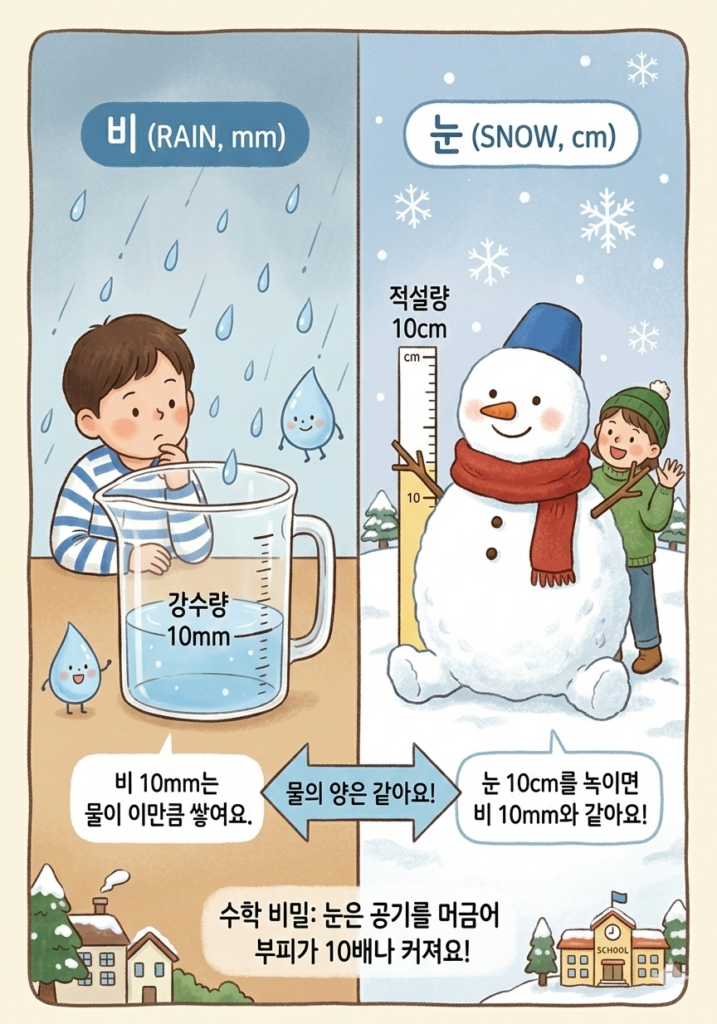
- Precipitation means the depth of ‘water’: Precipitation is a unit that shows how high the water would rise if all the rain or snow were melted. That’s why ‘mm’ is used worldwide to compare the amount.
- Snow has much more ‘volume’ than rain!: Snow is made when water droplets freeze in cold air. At this time, a lot of air gets trapped between the snowflakes. So, the same amount of water can become 10 to 30 times larger in volume when it turns into snow.
- Math Secret: Usually, 1mm of rain equals about 1cm (10mm) of snow.
- Comparison: 10mm of rain is only 1cm high, but as snow, it can pile up to 10cm—reaching your ankles!
- Why does the actual amount feel so different?: Rain flows away or soaks in as soon as it hits the ground, but snow sticks together and piles up high, making it look like much more. However, if you melt all that snow into water, it eventually reaches the same height as the original precipitation.
🤔 Quiz Time
- Q1: If the precipitation is 20mm, approximately how many cm of snow would pile up? (Hint: 1mm of rain ≈ 1cm of snow)
- Q2: Between 10mm of rain and 10mm of snow, which one looks like “more” to our eyes? Why?